Rare-earth magnet announcements compress a long industrial chain into a few familiar nouns: mine, refinery, factory. That shorthand makes a planned tonne look like an operating tonne and hides the handoffs where material can still leave the United States or fail customer qualification.
The project takes the form of a dated map of the United States and allied NdFeB magnet chain from resource definition through separation, metal and alloy production, powder metallurgy, finishing, assembly, and customer qualification. Its purpose is to make the Western magnet supply chain legible enough to distinguish operating capability from announced capacity.
Research figure · twenty-stage industrial stack
Ore is only the first handoff.
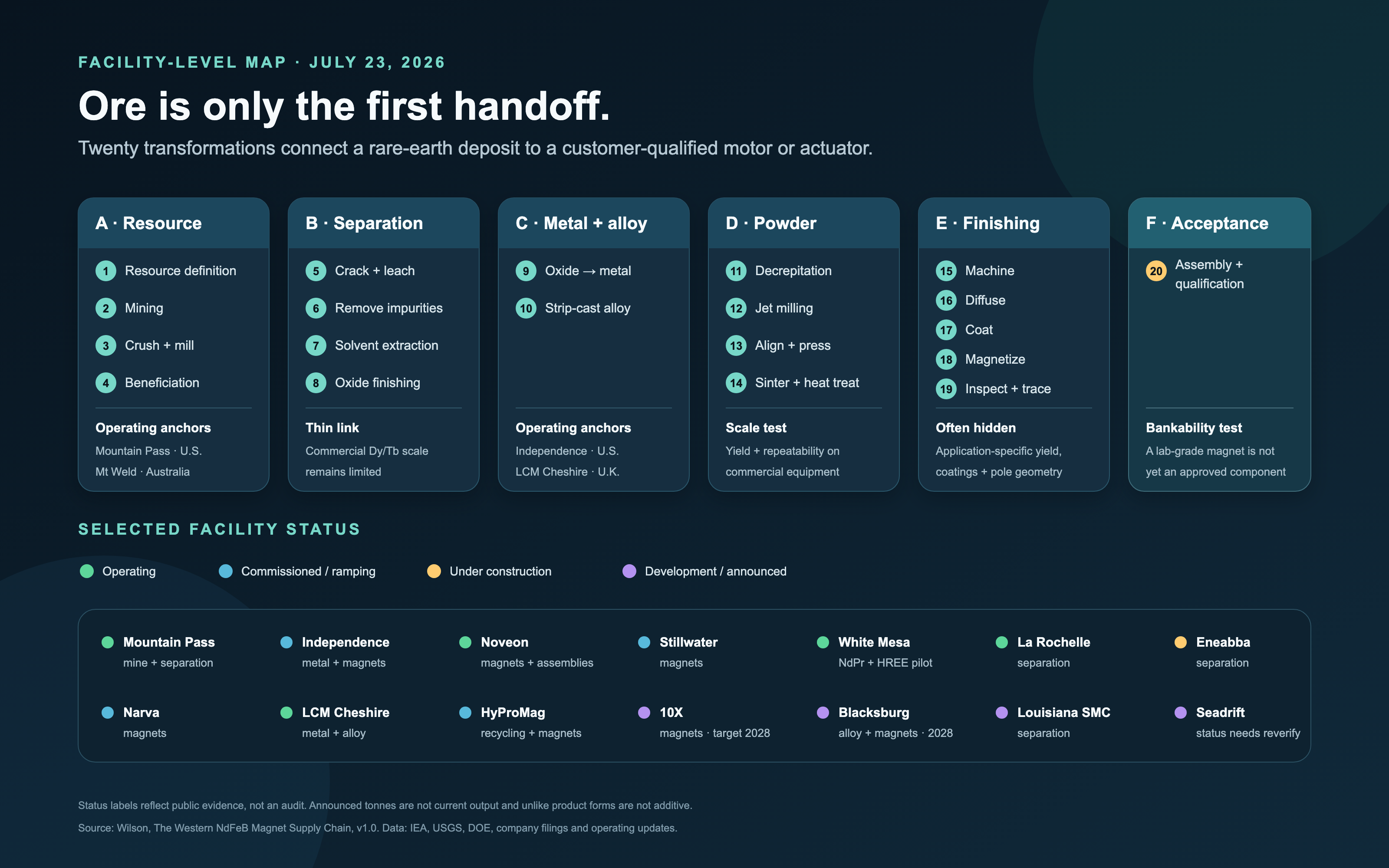
The map separates operating, commissioning, construction, and development claims instead of treating every announced tonne as present supply.
Status cutoff: July 23, 2026. Public-source classification, not an independent supplier audit.
Source: Wilson, The Western NdFeB Magnet Supply Chain, v1.0The question behind The Western NdFeB Magnet Supply Chain
The research question is operational rather than extraterrestrial or speculative: which named facilities in the United States and allied countries can perform which transformations today, what public evidence supports their status, and what still has to happen before their output is commercially substitutable? Existing government reports explain the high-level chain; this study reconstructs the dated facility layer. Manufacturing researchers, investors, policymakers, engineers, and readers tracking industrial reshoring can use the map as a verification starting point. Companies named in the study are affected by how public claims are summarized, so every facility row retains a dated source and caveat.
How The Western NdFeB Magnet Supply Chain took shape
The project defines twenty stages from resource planning to qualified assembly, then records each facility's product form, status verb, capacity basis, next public milestone, source, and verification caveat. Government statistics and technical reports were prioritized over filings, company updates, and secondary coverage. Announced design capacity remains separate from reported output, and unlike concentrate, oxide, alloy, and finished-magnet tonnes are never added together. I recognized the timely research opportunity, selected the facility-status problem, set the publication objective and evidence standard, reviewed the framing, and accepted responsibility for publication. OpenAI Codex performed the public-source research, synthesis, dataset construction, drafting, diagram design, and document production under my direction.
What the evidence supports
The public repository contains the 14-page paper, editable source, two machine-readable datasets, a reproducible document builder, twenty-two cited notes, and direct verification links for each facility record. The final Word artifact passed privacy and accessibility checks and was visually inspected across all rendered pages. The result supports a disciplined conclusion: Western capacity is real and growing, but it is not yet a deep, interchangeable market. Operating anchors now exist across mining, light-rare-earth separation, metal and alloy production, magnet manufacturing, finishing, and recycling. Heavy-rare-earth scale, sustained powder-metallurgy yield, downstream finishing, and customer qualification remain thinner than headline announcements suggest.
The map is a July 23, 2026 public-information snapshot, not a supplier audit, mass-balance study, investment recommendation, or proof that announced projects will meet schedule, yield, product quality, or customer-qualification targets. Private commercial data and several major Asian incumbent facilities are outside the selected scope. Future editions can track milestone changes, add independently verified output and qualification evidence, and expand allied coverage without collapsing unlike tonnes into a single capacity number.