Public information can be legally available and still be practically invisible. Meeting agendas, permits, maps, documents, and infrastructure records often live in separate systems, use different identifiers, and shed their context when copied elsewhere.
The project takes the form of an open, source-linked civic workspace for Kootenai County, Idaho. It connects public meetings, documents, agenda items, permits, infrastructure records, projects, events, claims, and sources in a reproducible local database and web interface. Its purpose is to make local public information easier to inspect, connect, and verify.
The question behind Kootenai Civic Data
Kootenai Civic Data treats provenance as part of the product rather than a footnote. A meeting should remain connected to its documents; a project should remain connected to its permits and sources; and a visible claim should retain enough collection history for another person to inspect it. Residents, journalists, researchers, civic groups, and public staff who need to trace local activity back to its source. Person-level permit and address material requires aggregation or removal before public release.
How Kootenai Civic Data took shape
The project developed as two connected layers: a reproducible civic graph that organizes source-linked records, and a local exploration workspace for search, maps, record inspection, exports, and source health. OpenWaterTowers can contribute a narrower infrastructure dataset without becoming indistinguishable from the broader civic system. I defined the civic-infrastructure scope, source and provenance model, privacy boundary, interaction goals, and acceptance criteria, working with coding agents to implement and test the vertical slice.
Working output · current-picture view
The interface begins with what a resident can inspect now.
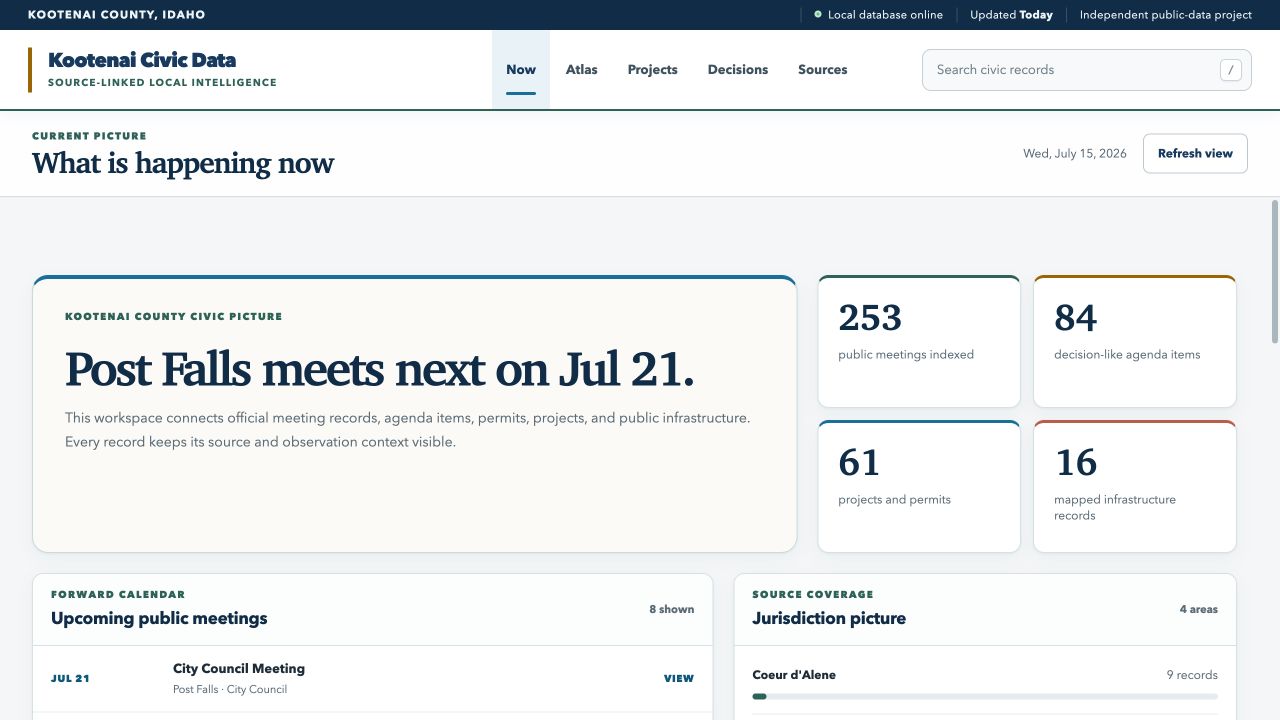
A local snapshot brings meetings, projects, infrastructure records, and source coverage into one view while keeping the underlying public records attached.
Source: Kootenai Civic Data design QA capture · July 2026What the evidence supports
The working snapshot contains 253 public meetings, 665 linked documents, 242 agenda items, 500 permit-report archive records, 61 project or permit records, and 20 linked evidence sources. Its central contribution is a model of civic legibility. The point is not to make public records look certain, but to make their relationships, gaps, collection paths, and freshness visible enough that residents and researchers can reason about them responsibly.
The current builder produces a trustworthy snapshot but does not yet preserve append-only observations across rebuilds. A public edition must remove or aggregate person-level address data. The next development stage is append-aware observation history and change events, followed by a curated or synthetic public snapshot with privacy-reviewed screenshots.